Why transformative change in the age of AI is ultimately a human and organisational challenge
From the 2026 edition of Business Agility by Serious Fun Infusion
What if the biggest constraint on transformation in the age of AI isn’t technology — but the organisation’s ability to change with it?
AI is accelerating how we analyse, decide, create and work. Automation is reshaping business models, roles and processes, while digital systems continue to change how we lead and collaborate. The possibilities are extraordinary. But technological capability does not automatically become organisational capability. Organisations still need to make choices, shift priorities, organise ownership, lead through uncertainty and create an environment in which people can learn, challenge and adapt.
And transformation still depends on one fundamental truth:
Organisations change only when people change.
Not systems | Not processes | Not frameworks. People.
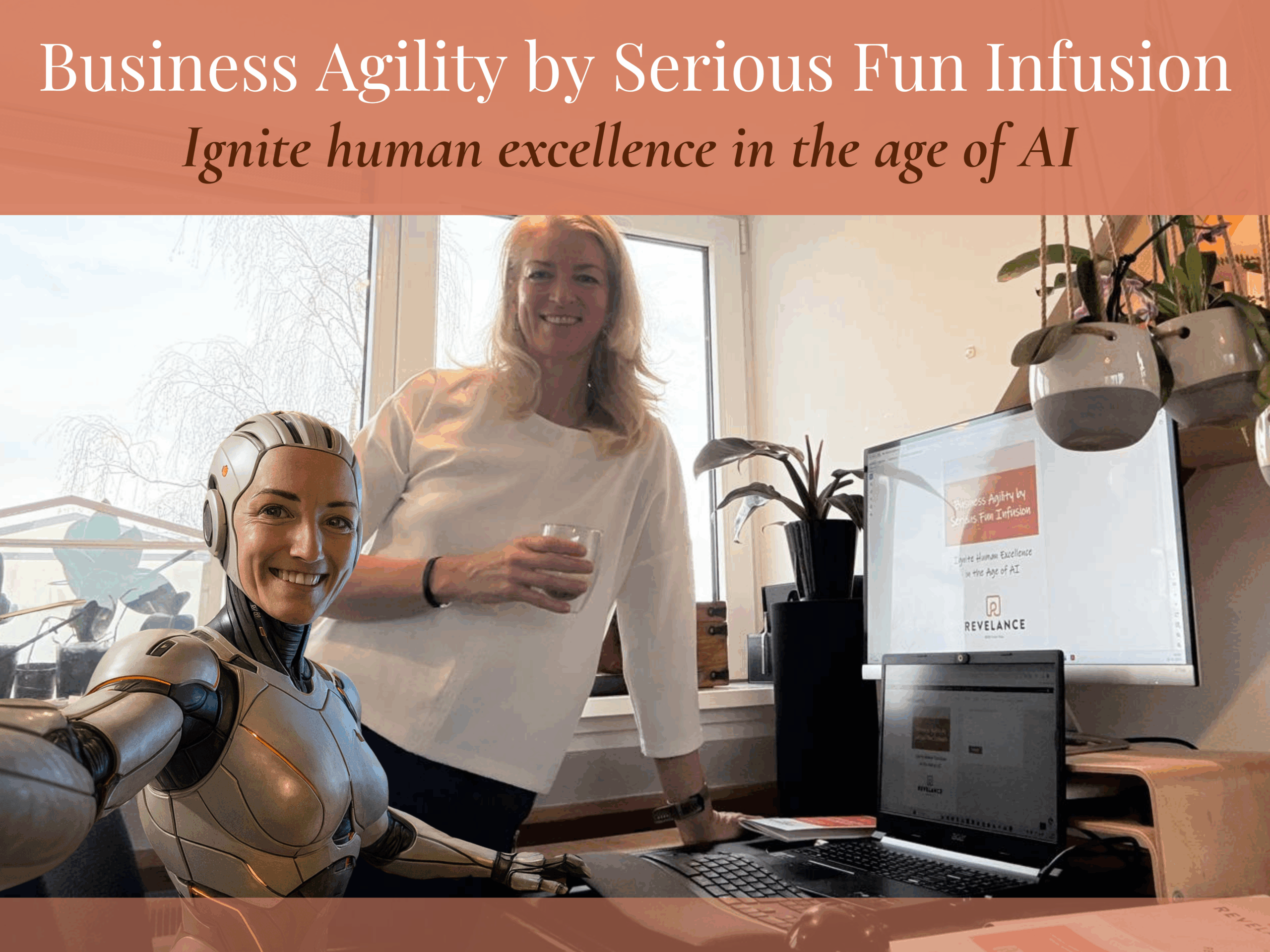
This is the starting point of the 2026 edition of Business Agility by Serious Fun Infusion – Ignite Human Excellence in the Age of AI.
The booklet explores the human foundation beneath transformation: the mindsets, emotions, needs, drivers and behaviours that technology cannot simply solve for. Over the years, my perspective on transformation has broadened further. I increasingly see this human foundation as inseparable from the organisational system around it. Sustainable transformation happens when strategy, governance, organisation and execution move together with leadership, behaviour and culture.
Human excellence matters. But organisations also need to create the conditions in which that human potential can become ownership, adaptability and meaningful results.
These seven insights explore that intersection.
1. Technology accelerates, humans determine the real pace of transformation
AI, automation and digital systems can change work faster than organisations can redesign themselves around them. Roles shift, responsibilities change, new capabilities become necessary and established ways of working lose their relevance.
The constraint is therefore rarely technology alone. It is the organisation’s capacity to absorb and translate technological possibility into meaningful change.
People need clarity about where the organisation is going and why. They need the ability to learn, contribute and challenge existing assumptions. And they need sufficient trust and psychological safety to move into territory where not all answers are known.
Technology can accelerate change. But whether that change takes root still depends on people — and on the organisational environment around them.
The future of work is not just digital. It remains deeply human.
2. The most essential skills of the future are uniquely human
As AI becomes increasingly capable of performing routine, analytical and knowledge-intensive work, our distinctly human capabilities become even more strategically important:
- empathy and emotional intelligence
- creativity, imagination and innovation
- narrative thinking & storytelling
- intuition & judgement
- humour, connection and play
- curiosity & learning agility
AI can augment many of these capabilities and increasingly mimic aspects of them. But organisations still depend on human judgement, relationships, meaning and responsibility to determine what should be done, why it matters and how people move forward together. The question is therefore not how humans compete with machines, but how organisations strengthen what people uniquely contribute while using technology to amplify their capabilities.
3. The quiet truth: the human layer beneath every transformation
Under every strategy, governance model, transformation roadmap and backlog lies another layer — quieter, less visible and often far more decisive.
People ask themselves:
- Am I safe enough to speak?
- Does my contribution matter?
- Do I have meaningful autonomy?
- Do I belong here?
- Does this change make sense?
- Do I believe we can actually succeed?
These questions point to fundamental human needs:
- psychological safety
- recognition
- autonomy
- belonging
- meaning
- hope
When these needs are sufficiently supported, people are far more able to contribute, learn and take ownership. When they are ignored, resistance, withdrawal and compliance can grow beneath seemingly sound structures and plans. This is what I call the Quiet Truth beneath transformation. We can redesign structures, processes and governance, but sustainable change also requires attention to what people experience beneath the surface.
4. Fun is not entertainment — it is a strategic driver of change
One of the most underestimated forces in transformation is fun.
Not fun as entertainment or an escape from serious work, but as a psychological state characterised by energy, curiosity, engagement, connection and possibility. Change often asks people to leave behind what they know, experiment with something uncertain and learn while performing. When the environment is dominated by fear, pressure or fatigue, curiosity narrows and people become more likely to protect what they already know.
Positive energy can create the opposite movement.
Serious Fun Infusion can lower perceived barriers to participation.
It can accelerate learning.
It can stimulate creativity.
It can strengthen connection and ownership.
That makes fun more than a pleasant by-product of transformation. Used authentically, it can become a strategic driver of movement and learning. It helps shift the experience of change from:
“I have to change”
towards:
“I want to contribute to this change.”
5. The REVELANCE model: how change truly works
Over years of working with transformation, I have found three questions particularly useful for understanding why people move — or why they do not. Real change happens when three human drivers align:
1. Rational drive — “Do I want to achieve this?”
Is there clarity about the ambition, direction and priorities? Do I understand what we are trying to accomplish and why these choices make sense?
2. Emotional drive — “Why is this worth it to me and to us?”
Do I feel connected to the purpose, the people and the desired outcome? Is there meaning, appreciation, energy and hope?
3. Driveway — “Can I realistically make this happen?”
Is there a credible route forward? Do roles, governance, resources, capabilities and support enable me to contribute? Is it safe enough to learn, experiment and adjust?
When these three conditions reinforce one another, the likelihood of genuine movement increases. People understand the direction, feel connected to it and experience that they can actually contribute. That creates something much more powerful than compliance: ownership.
6. Leadership must evolve from control to direction, connection and ownership
Complexity and AI do not make leadership less important. They make the quality of leadership more important. When circumstances change quickly, leaders cannot control every decision or provide every answer. But neither is leadership simply about stepping back and “empowering people”.
Future-ready leadership requires the ability to:
- create clarity about direction and priorities
- make and enable difficult choices
- build trust and psychological safety
- organise ownership close to where knowledge exists
- invite challenge and dissent
- connect different perspectives across organisational boundaries
- create conditions for learning and adaptation
- remain accountable for meaningful results
Leadership therefore shifts from controlling execution towards creating the conditions in which people and organisations can perform, learn and adapt. It combines direction with trust, accountability with autonomy, and decisiveness with curiosity. Leadership becomes less about authority, and more about human excellence.
7. Business agility requires organisational and human agility
Frameworks such as Agile, Lean, SAFe and Continuous Improvement can provide useful structures and practices. But no framework creates agility by itself.
At the same time, human energy, collaboration and engagement alone are not enough. An organisation can have highly motivated people and still struggle to change when priorities remain unclear, governance slows decisions, ownership is fragmented or leaders send conflicting signals.
True adaptability emerges when the organisational system and the human system reinforce each other.
- Strategy provides focus.
- Governance enables choices and ownership.
- Organisation creates clarity about roles and responsibilities.
- Leadership provides direction and trust.
- Culture shapes how people collaborate, challenge and learn.
- Execution turns ambition into meaningful results.
People bring the judgement, curiosity, courage and energy that make the whole system come alive. That is why I see business agility today as more than a way of working.
It is an organisation’s capacity to continuously adapt while remaining purposeful, coherent and human.
AI accelerates what is possible. Human excellence determines what we do with it.
The organisations that can bring both together will be better equipped not simply to respond to the future — but to shape it.
A personal invitation
Business Agility by Serious Fun Infusion – Ignite Human Excellence in the Age of AI is an invitation to look beyond technology, frameworks and transformation programmes and explore what organisations and people actually need to keep changing successfully.
The booklet brings together the human principles, practical insights and experiences behind this perspective.
 Download the full 2026 edition of the booklet “Business Agility by Serious Fun Infusion”
If these questions resonate with a transformation you are leading, I am always interested in exchanging perspectives.
Kirsten Baas | REVELANCE | Leading Transformative Change
Transformation Lead | Interim (Program) Director | Strategic Transformation Advisor
Let’s talk: baas@revelance.nl | revelance.nl | +31-6 16 03 79 17 | schedule an appointment | follow me on LinkedIn